Saturday, 25 August 2018

ESSAY: SOME THOUGHTS ON ROBINSON JEFFERS' POEM "ROCK AND HAWK"

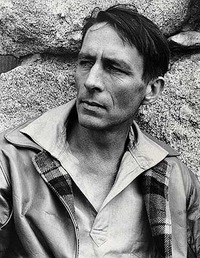
ROBINSON JEFFERS
I wrote this some time ago, while attending U of T part-time in the early 1990s. It was a third-year course on modern poetry taught by Albert F. Moritz, himself a published poet (I have one of his collections on my shelf). In re-reading this essay after all this time, I am reminded of how much I enjoyed taking his course. I think I learned from him that reading poetry is something that everyone can do (and should!) It is not an elitist pastime or written for an ‘in-group’ of esoteric practitioners (though it can be.) At its best, poetry tells us what we are, where we are, how we are. Poetry, I’d like to think, is literally part of our human DNA. It comes from humanity’s oral traditions going back millennia to when we first discovered our innate ability with language. The sound of the human voice is poetry, and between the poet and the listener (or reader) is an attempt at communication that is beyond words. Finally, poetry tries to bridge the gulf between ourselves and the rest of the world (human and non-human.) We tend to think of language (and poetry) as uniquely human, but the songs of whales and birds, and the cries and sounds made by the myriad other creatures we share this world with, suggest to me there many, many poems yet to be written. It may be our privilege someday to read them.


Rock and Hawk

by Robinson Jeffers
Born: January 10, 1887
Died: January 20, 1962

Here is a symbol in which
Many high tragic thoughts
Watch their own eyes.

This gray rock, standing tall
On the headland, where the seawind
Lets no tree grow,

Earthquake-proved, and signatured
By ages of storms: on its peak
A falcon has perched.

I think, here is your emblem
To hang in the future sky;
Not the cross, not the hive,

But this; bright power, dark peace;
Fierce consciousness joined with final
Disinterestedness;

Life with calm death; the falcon's
Realist eyes and act
Married to the massive

Mysticism of stone,
Which failure cannot cast down
Nor success make proud.


The Magnificent View:
The Emblematic Landscape of Robinson Jeffers 
As Seen in His Poem “Rock and Hawk”

     In the poetry of Robinson Jeffers, it is the great granite cliffs of the Pacific Northwest that soar, timeless and solitary, in his imagination.  It is the bedrock underneath the soil with its granite outcroppings breaking the surface that penetrate his language and infuse his images. The unchanging sea, sky and mountains of Point Lobos are, for him, the source of his inspiration and the final answer to his questions. The rest—the forests and land, plant and animal life, and human life, as well—all these are ephemeral, temporary, merely a part of the “surface of things” (“Fawn’s Foster Mother” Norton line 19). He looks instead to permanent things, in life as well as in poetry. In the introduction to a collection of his poems, Jeffers states that poetry must “concern itself chiefly with permanent aspects of life” and he goes on to say, “poetry must deal with things that a reader two thousand years away could understand and be moved by.” (Selected Poetry xiv).

     In poem after poem, Jeffers restates this theme and portrays the magnificent coastline of Northern California as his emblem of permanence in an otherwise changing and transitory existence. “Rock and Hawk” is a poem that typifies Jeffers’ concern for depicting humanity’s preoccupation with the transitory aspects of life instead of addressing directly those permanent and unchanging features he sees represented in the landscape and in such things as “the strong / Tribal drum, and the rockhead of Taos mountain,” (“New Mexican Mountain” Norton, 12).
In “Rock and Hawk”, he addresses how and where human beings engage with the physical world, and whether the means they choose to understand it and their relationship to it are adequate. For a poem whose title suggests the physical world, most of the poem curiously concerns itself with abstractions. The speaker begins by addressing—who? Is it the reader, or a potentially like-minded observer? Does the speaker address himself; perhaps all three? Who is unclear, nevertheless, the speaker begins by expressing a concern. This ‘concern’ is not initially suggested in a reading of the first three stanzas. It is only with the fourth and the use of the word “emblem” (10) that the reader is alerted to what Jeffers sees as the inadequacy of symbol: an abstraction, he suggests, at a further remove from the physical world than is the emblem. While both are abstract concepts humans use in dealing with the physical world, an emblem, he proposes, retains more of its physical connection to the world and, as such, it is more useful as a guide in directing the user to more clearly see the physical reality of the world and the user’s relationship to it. Jeffers implies that this reality is often obscured through the use of such abstractions as symbol.

The central image of the poem is of a hawk perched atop a tall “gray rock” (3) on the headland overlooking the sea. The poem explores how human beings react to, and interpret, this scene. The first stanza suggests that the observer could view the scene in front of him as merely a symbol of his own internal state. The speaker says that many observers do just that: in looking at the rock “standing tall / On the headland” (4-5), many see themselves in what they imagine it is they are seeing before them. They imagine a “tragic” (1) setting of gray rock, isolated and barren. In the landscape before them, they only see themselves. With their idea of the landscape as symbol, as merely a projection of their own internal states, they can form no connection to it, nor develop an understanding of it. They are merely sentimental, Jeffers suggests, lost in their own “high tragic thoughts,” (2). What they see is what they are.

At this point, Jeffers’ speaker provides guidance to his listener. (Again, is the listener the speaker, a fellow observer, the reader, or all three?) He does so by providing information that acts to clarify the scene that is before them: It is not a sentimentally tragic one. For example, the gray vegetation-less rock is not barren, as those who hold it as mere symbol of how they see themselves would have it. Rather, its barren quality comes instead from the sea wind that “Lets no tree grow,” (6) there. This line suggests that the rock is not—by its nature—barren. In reality, the sea wind keeps the tree-bearing soil from taking root there. Neither, the speaker says, is the rock isolated. He clarifies further by stating that the rock’s essential nature is “Earth-quake proved,” (7). The rock has been tested by earthquakes, and by implication, has proved itself adequate. The “ages of storms” (8) have also given to the rock their ‘stamp of approval’, adding their signatures in the form of weathering and scarring to its surface. Thus, the rock is neither barren nor isolated. The speaker’s clarifications refute the tragic image of the rock held by the sentimental observers. In reality, this is a place of ancient and tempered strength. It is a tall place of endurance, and it is to this clarified image that the speaker adds the falcon.

Whether the falcon was perched atop the rock initially, or as the speaker may be suggesting, it arrived later, the sentimental observers in their tragic, self-absorbed viewing of the rock do not see “on its peak / A falcon has perched” (7-8). In either case, the crucial element of the falcon is missed. Thus, the speaker now guides his listeners to the powerful, emblematic nature of the image that is before them. The speaker continues his guidance by suggesting that this real, physical scene is an emblem. It represents something. This ‘something’ is, as yet, unidentified by the speaker, but it is something that is better than the traditional emblems of the “cross” and the “hive” (12). He suggests that these traditional emblems (of Christianity and of communal-technological man, suggested by the hive) are inadequate. Interestingly, he does not state, directly, that it is Christianity or modern technological society he finds inadequate. Rather, he says, their emblems fail. He suggests that while such emblems are themselves symbols of physical objects, they nevertheless represent abstractions (Christianity and technology). By implication, the speaker suggests that any society or individual that uses such emblems is inadequate, hence his emphasis on the adequacy of his emblem: the physical landscape before them. He sees his own discovered emblem as both physical and abstract to a degree far greater than the traditional emblems he criticizes: for the speaker, the idea does not differ from the physical reality; there is no abstract ‘symbol’ between the observer and what he sees.

Here, the subtlety of Jeffers’ poem emerges in the movement of the ending stanzas. The speaker has said abstractions distort our perceptions of reality and that symbols must be based on the physical reality of the world. He says, in essence, here is the great symbol of the falcon and the rock to hold up to the future. In the final three stanzas, the speaker describes this emblem, but almost entirely in abstract terms, with abstractions suggesting paradox and the blending of opposites, and ultimately, suggesting mystery. He describes the emblem of the rock and the falcon as a blending of opposites: of “Bright” with “dark”, of “power” with “peace” (13), and of “consciousness” with “disinterestedness” (14-15). Stanza 6 suggests the emblem as a joining of abstractions: “life” with “death” (16).

The physical image of the falcon’s eyes is made more abstract by the speaker’s use of the phrase “Realist eyes and act” (17) to describe them. As well, the image of the rock itself as a “massive / Mysticism of stone” (17-18) is an impenetrable abstraction. The final blending of these two abstractions, of the falcon’s “Realist” eyes and the “Mysticism” of the stone is an emblem that defies the creation of any clear and specific image. This would suggest there is a contradiction in the speaker’s desire to create an emblem to “hang in the future sky” (11) except that the reader is reminded of Jeffers’ concern with the use of abstractions in general. His speaker does not attempt to create a final and clear emblematic image because this, too, no matter how faithful it is to the original, would be at a remove from the physical reality witnessed by the observers.

The last three stanzas suggest the dilemma of human beings as they confront the physical world. As symbolized by the falcon and the rock, the “bright power” of organic life lay side-by-side with the “dark peace” of the physical world; and it is a peace that does not change, nor does it answer back to life: it simply is. In his poem, Jeffers suggests this side-by-side existence by subtly placing a comma in between the two descriptions (“bright power, dark peace”). Next, humanity’s consciousness is a “Fierce” and active force that “joins with” (14) the disinterested physical world. Jeffers phrase suggests this joining is not so much a mutual blending-together, as more like an uncomfortable partnership. He suggests humanity grudgingly, though necessarily, joins with the physical world, and in his use of the word “Disinterestedness” (15) he conveys the sense of dissatisfaction human beings often feel when confronted with the silences of the physical world. However, as Jeffers’ speaker continues to describe this emblem, there is a movement toward greater unity with the rock than suggested by the choice of connective words used to link the descriptions of opposites. For example, the speaker goes on to say that life is “with” (16) death. This word suggests a more normal or acceptable joining. Furthermore, death is characterized as “calm” (16) which also suggests the sense of a stronger bond and a greater ‘acceptance’ by life of its opposite.

The final image moves closest to a sense of sublime unity with the physical world that Jeffers’ speaker hopes to achieve with his description of his emblem. The “Realist” eyes of the falcon, the eyes that do not see the landscape as sentimental projections of the self,  but rather as it is, and the “act” of the falcon, its supreme, bird-like essence, both now, are “Married” (17) to the “massive /Mysticism of stone”. The image of marriage suggests an ultimate bond of mutual acceptance. In terms of human beings, the falcon and the rock represent the marriage of consciousness with a final and profound mystery, a mystery that cannot, and will not, be explained. The final two lines of the poem remind the reader that by using such an emblem (the emblem of the real, physical world) to guide us, we will not be distracted by the abstractions of symbols. With such an emblem, Jeffers says, neither the failure of the Christian, nor pride of the modern, will distract us from being simply with the world as it is.

Works Cited


Jeffers, Robinson. “Fawn’s Foster Mother”. The Norton Anthology of Modern Poetry. Ed. Richard Ellman and Robert O’Clair. NY: Norton, 1988. 431. Print.

---. “New Mexican Mountain. NY: Norton, 1988. 433. Print.

---. “Rock and Hawk. NY: Norton, 1988. 433-34. Print.

---. Introduction. The Selected Poetry of Robinson Jeffers. NY: Random, 1959. xiv. Print.


Professor Moritz’s Comments:


Jeffers’ Emblematic Landscape in “Rock and Hawk” A+

      Don, this is a very rewarding paper. It is like your last but perhaps still better in patiently bringing out the depths of the poem and enriching what might be taken by casual reading as seemingly plain meaning. The end of your paper (from 3.2 onwards) [para. Beginning with “Here, the full subtlety of Jeffers’ speaker…”] seems to me true in every respect, and superb. I cannot agree with the theme of your first two pages, nor can I see that it is necessary. Taking your analysis as seriously as possible, I cannot see that RJ is expressing an important symbol/emblem contrast or criticizing people for being limited by “tragic symbolic” views. The issue seems rather : what is the use and meaning of symbol-or-emblem, and what is the proper one; it seems clear to my [sic] the tragic thoughts watching their own eyes are a statement of how the real components of the universe and of a properly regulated human mind confront each other—in a nature-like “beyond this life” purity. These poised, silently watching, mutely interrelated thoughts are precisely those detailed in the list of the last three stanzas culminating in the two married opposites, the hawk and the rock, the life that reaches to an is mysteriously part of what is beyond-life: “huge shapes / That do not live as living men,” says Wordsworth. Your ending comments—on marriage—are especially fine. In general, the depths of your paper do not hinge on whether you are right or not on this “symbol” question but go to a deeper heart of the poem. A few misspellings” p.2 clarifys (clarifies); p4 delimma (dilemma); p.5 destract (distract). Excellent work.

………………


Tor House: Built by poet, 1919-1924
I also include a link to an essay, “The Falling Years: An Inhumanist Vision”, by John Michael Greer, written for the British publication The Dark Mountain Project a few years ago, in which JMG discusses the work of  Robinson Jeffers.

DO DO THE DOODLES ALL DE-DOODLE-LONG DAY

Jeeps and Jops realized the jig was up!
AS ALWAYS, RANDOM PICS FROM the galleries: The JEEPS AND JOPS pic was done waaay long ago, as was GET A ROOM, with that weird black and white landscape. (Oopsie! It looks a bit too sexual, then again, so does a lot of my stuff. I'm not going to touch that with a ten foot pole!) 
THE BUDDHA is just cool, and he/she is everywhere, man--around the corner, in a raindrop, beside a fence, or standing next to you.

The pic FACES reminds me that we meet many things in the dark, people popping in and out of view all the time; they're not usually dangerous, but often unexpected and challenging. It's not so much what we do initially  that's important, it's what we do afterwards that counts.
PARK BENCH That's me sitting on a park bench in the fall. I thought it would be a good illustration to end my first collection of poetry, if I ever had one. 

Get a Room!
And OUTSIDE MY DOOR: I just liked the urban landscape drawing; that's what I see when I walk down the street. Don't you? FLOWERS FROM MY BABY. And the pot of psychosis flowers I thought appropriate to put at the end of things. Don't sniff too closely, though....

da Buddha

Faces in the Dark

Park Bench in Late Fall

Outside my Door

Flowers From My Baby


ESSAY: THE POEM, "THE MILL", BY EDWIN ARLINGTON ROBINSON

     I thought I would put in a second essay written for the same Modern Poetry class I took with Professor Moritz back in the Paleolithic years. I can remember typing it out on a word processor which had a tiny screen that displayed a single line of text. Wow! Nineties' tech rocked! Now of course we have the World Wide Web and smart phones that can launch spacecraft into orbit. We have come a long way, baby! Pretty soon, AIs will be able to write our stuff for us so we can be free to sit around all day popping bubble wrap and await the Singularity
     I figure that if I can read and write about poetry, and even make my own attempts at writing the stuff, then so can you. And until we are either swallowed up by The Machine, or spit out of same, we should try and do a little readin' and maybe even some writin'. It can't hurt.
    And don't forget, we still have to deal with love and sex and despair and death, and all the rest of the squishy, icky, human mess we call our lives; just like the miller's wife and her significant other.


The Mill
By Edwin Arlington Robinson
Born: December 22, 1869
Died April 6, 1935

The miller's wife had waited long,
The tea was cold, the fire was dead;
And there might yet be nothing wrong
In how he went and what he said:
"There are no millers any more,"
Was all that she had heard him say;
And he had lingered at the door
So long that it seemed yesterday.

Sick with a fear that had no form
She knew that she was there at last;
And in the mill there was a warm
And mealy fragrance of the past.
What else there was would only seem
To say again what he had meant;
And what was hanging from a beam
Would not have heeded where she went.

And if she thought it followed her,
She may have reasoned in the dark
That one way of the few there were
Would hide her and would leave no mark:
Black water, smooth above the weir
Like starry velvet in the night,
Though ruffled once, would soon appear
The same as ever to the sight.


 “The Mill”: Disturbing Silences in the Poetry of Edwin Arlington Robinson

Edwin Arlington Robinson wrote poems that portrayed the people he met and the society he lived in. He wrote about politics and history and human relationships. In particular, he wrote about the relationships between men and women. His interests and subject matter were wide-ranging, but despite this eclecticism, his poems were often cautious and subdued in form and tone. There is an air of quiet regret and failure to be found in many of them. In his poems, he often suggests that knowledge comes too little or too late, or is acted upon futilely. The present is seen as a place where the mistakes of the past are made, again and again. His form suggests caution by his use of traditional stanza, meter and rhyme schemes. His tone is subdued in that many of his poems end, seemingly unresolved, with their characters failing to achieve insight. As well, his poems often have the sense that the speaker accepts a view that suggests the inevitability of human failings, including the speaker’s own. This is in contrast to the ironic detachment, often found, in the speakers of many of Robert Frost’s poems, the irony being seen in the difference between what the speakers observe, and what they know to be true or know can be true. Such detachment is not usually found in Robinson’s poetry. His speakers are seen to share the shortcomings of those they observe and portray to a greater extent than those of Frost. If his poetry reflects his life, then life seems to have held few rewards and many defeats for Robinson.
“The Mill” is a dark and disturbing poem whose explicit storyline—the discovered suicide of the miller and the contemplated suicide of the miller’s wife—are made all the more unsettling by the manner in which Robinson’s speaker reveals the details of the story. The speaker implies much of the story’s actions. We are not told directly, for example, that it is the miller who was “hanging from a beam” (line 15) inside the mill, nor are we told, specifically, that the miller’s wife is contemplating suicide. As well, the speaker uses phrases that are ambiguous and often puzzling. For example, what does he mean by the following: “What else there was would only seem / To say again what he had meant;” (13-14)? An initial reading can make little sense of these lines. There is the sense in his descriptions that the speaker leaves much unsaid. What we shall discover in these ‘silences’ on the part of the speaker is that they mirror the silences that lie at the heart of the relationship between the miller and his wife, silences that both characterize and define their life together and which ultimately destroy it.
The explicit story line suggests the miller’s wife waited a “long” (1) time for her husband to return, time being gauged by her domestic routines of making tea and tending to the hearth fire. Alerted over what she comes to realize was a disturbance in her husband’s mind, she goes to the mill and discovers his body. Apparently distraught and confused (she was reasoning “in the dark” 18), she, herself, now contemplates suicide in the “Black water, smooth above the weir” (21). It seems a tragic tale and a simple one: one of advancing technology eliminating a husband’s livelihood, of his ensuing despondency and subsequent suicide, and the suggestion his wife will follow him in death. It is a tragic tale, but as we shall see, it is not a simple one. The poem’s title suggests it will be concerned with a description of the mill; the poem is entitled “The Mill”. However, it is only indirectly that Robinson’s speaker deals with the mill at all. We see it only through its smell, the “mealy fragrance of the past” (12) and in the image of the “beam”. Thus, the poem’s physical structure, in terms of its title and body, suggests there will be an examination of the indirect, not the direct, the subtext, not the text. Here, in these two images of the mill, Robinson provides the first clue that suggests the poem will deal with the indirect, unspoken, silent aspects of the relationship between the miller and his wife.
Robinson provides a second clue suggesting this emphasis, this time in his choice of meter. I have said that Robinson’s poetry is characterized by his use of traditional meter forms. This poem is no exception. It is a four beat per line, standard iambic measure—except for one line. Line 2 has a fifth stressed syllable caused by the addition of the word “was” (2). The rest of the poem is metrically unbroken; only here is it disrupted. With his emphasis on the word “was”, Robinson seems to suggest that, while his poem describes the present moment of the relationship between the miller and his wife, his real concern is with their past. Alerted to Robinson’s special interest in time, the reader notes the odd descriptions of time the speaker provides in the first stanza: the miller’s wife “waited long” (1). Presumably, she waited a long time, but the phrase is vaguely uneasy. So, too, is the line, “[a]nd there might yet be nothing wrong” (3), that, again, makes sense enough, but is somehow unstable. The description of the miller as he ‘lingered” (7) at the door, seem straightforward , but the suggestion in the following line that he lingered so long it “seemed yesterday” (8) is puzzling.
In the first two stanzas, the speaker describes the thoughts and feelings of the miller’s wife, but there is a question as to whether he is directly transcribing them for us or is interpreting them instead. For example, the line “And there might yet be nothing wrong” could easily represent the speaker’s thoughts as he foreshadows the miller’s wife’s discovery of her husband’s body in the mill. The line could also suggest the thoughts of the miller’s wife as she clings to the hope that nothing has gone wrong—yet—because she has not yet discovered anything wrong. Robinson is again drawing our attention to the indirect in his poem by making us question just how directly a view of the miller’s wife we are actually getting. In doing so, he reminds us there is more to learn about the miller’s wife, but only indirectly. Robinson assists the reader in this process by providing perhaps his most important clue in his two descriptions of the mill. Here, in stanza 2, his speaker chooses words to describe the mill that have direct meanings that are at odds with their indirect meanings, and it is these indirect meanings that provide the reader with a clear understanding of the nature of the relationship between the miller and his wife. The speaker describes the smell of the mill as a “warm / And mealy fragrance” (11-12).  The obvious or direct meaning of the phrase changes considerably when the connotative meanings found in the words “mealy” and “fragrance” is examined. Mealy suggests mealy-mouthed, or tending to be indirect or obscure in speech, or not to use plain language. Fragrance has the sense of being affected or artificial, in other words, not a natural scent. The two together suggest that the “past” (the past of the miller and his wife, their life together), was characterized by artificiality and indirectness. In his second description of the mill, Robinson’s speaker uses the word “beam” in the line, “And what was hanging from the beam” (15), suggesting, by interpreting the word more closely, that her husband had move away from the path he had been on with her, that he had gone ‘off the beam’, as it were. The speaker suggests that the miller would no longer have followed her, that he would no longer have “heeded” (16) her.
With this new understanding of the character of the miller’s wife, we can now examine and make sense of some of the images from stanza 1 and 2. Her life and their domestic life together were as cold as her tea. Their “fire was dead” (2); the passion of their past life was now only “warm” (11). The miller “lingered’ at the door because he was dying. He lingered on in a relationship that only “seemed” like it was yesterday; yesterday was dead. She, herself, had “waited long” in the relationship: she had waited, not long in time, changing and growing over the course of their life together, but, rather, she waited obscurely, unchanging and indirectly. She had barely touched life or let it touch her. Now the enigmatic line of the miller is clear: “‘There are no millers anymore’”, he had said. It is an example of the indirect, obscure and ‘mealy-mouthed’ dialogue that had come to characterize their conversations. She did not attend to the real message of his words (I am in despair) because she could only hear the same words they had exchanged all their lives. Finally, the cryptic lines, “What else there was would only seem / To say again what he had meant[;]”, suggest that even the physical fact of her husband’s body (it is a “what” to her), its physical reality is obscure to her and only “seems” to say what he meant. By the end of stanza 2, the reader is unclear as to whether the miller’s wife understands the implication of his suicide. Stanza 3 does not clear up the matter.
The sense that she is close to confronting the reality of her life is suggested when the speaker says she was, “[s]ick with a fear that had no form” (9). Her life, up to that point, had been arranged carefully—formally—by the domestic routines that both she and her husband had accepted and the silences they both had never intruded upon. Robinson aptly suggests this moment of realization had always been with her in the following lines that have her move, apparently without any physical effort, into the mill. “[S]he was there at last; / And in the mill (10-11). If these lines suggest that the miller’s wife is about to confront her guilt, the final stanza leaves the reader wondering. The first four lines of stanza 3 suggest she is contemplating her guilt, as well as her suicide, but interestingly, the speaker’s observations are qualified with, “[a]nd if” (17) and “[s]he may have” (18), suggesting, clearly, that at this point, the speaker is not aware of her thoughts. He assumes if she feels guilty, that is, if her guilt “followed her” (17), then she would be thinking of suicide. The speaker goes on to suggest that she would then contemplate a suicide that “would leave no mark” (20). The reader feels here that the speaker means the miller’s wife would be concerned about a suicide that would disfigure or mark her body. Suicide by drowning would alleviate that concern, but the imagery of the last four lines suggests that the “mark” the speaker assumes she would be concerned about is not a mark upon her body, but upon life. The water above the weir is described as “velvet” (21) and though it is “ruffled” (23) once (as by a body falling in), it soon appears exactly as it was before. It is interesting, however, to remember that this darkly beautiful imagery of an all-encompassing oblivion, with its smooth surface barely disturbed by human kind, comes from the speaker. The miller’s wife may or may not be considering suicide. She may not look upon the waters as an escape, as the speaker suggests. Furthermore, the feminine imagery that likens the water’s surface to ruffled velvet suggests this is the speaker imagining what the miller’s wife is thinking. It also suggests, as do the words  “mealy” and “fragrance” discussed earlier, a certain artificiality to the water: it may not be a real escape for her after all (though, it should be added, it does not seem to be the intention of the speaker to imply such ambiguity). The imagery of escape, of being swallowed up by death, nevertheless suggests the kind of life the miller’s wife has been depicted as living: she has lived life with an ‘unruffled’ surface. The final lines of the poem suggest her one desire may be to leave life as untouched as she lived it. This, however, may only be how the speaker feels.


Works Cited

              Robinson, Edwin Arlington. “The Mill”. Norton Anthology of Modern Poetry, 2nd ed. NY: Norton, 1988. 221. Print.


Professor Moritz’s Comments:

 “The Mill”: Disturbing Silences in the Poetry of E.A. Robinson  A
     Don, this is just excellent, patient, detailed, insightful reading of the poem; I’m privileged to have received it. I feel you attack EAR’s poetry just at the right places: its silences and apparent (which in some, less successful case, becomes real and impenetrable) obscurities. And you have illuminated them very well. Among the many excellences let me point to your reading of the last stanza, and of the speaker’s elation t the wife’s psychology in general: extremely well done. Let me suggest a related thought. One possible weakness, it strikes me, is that your thoughts on “mealy”, “fragrance” and “beam” are perhaps over-ingenious and questionable, although you certainly do make convincing use of them, which tends to add conviction to them. But you have ignored one strong factor that comports with your view and would perhaps help support your analysis of these words while bringing s in a linked and more certain idea. The fact that he “lingered at the door / So long that it seemed yesterday” implies securely that she did not answer him, or answer him satisfactorily, whether due to her insensitivity or their mutual alienation, and that he had waited for a response and for help that had not been forthcoming. It implies financial difficulty and resulting marital dissatisfaction; it makes the statement “There are no millers” into an ‘implicit suicide’ note expressed impersonally.  
    Unfolding from that are various possibilities, or at least leaving him to stew in his despair; that only too late she realizes the effect that this will have on her herself; etc. Such ideas support and add to your penetrating interpretation.